
From Champagne Toast to Building Blocks: How Serengeti Balloon Safaris’ Celebrations Are Building a Sustainable Future
From Champagne Toast to Building Blocks: How Serengeti Balloon Safaris’ Celebrations Are Building a Sustainable Future
There’s a moment at the end of every balloon flight that stays with you.
The burners fall silent. The Serengeti stretches endlessly beneath a soft morning light. And as the balloon basket touches down, a familiar sound follows - the gentle pop of a champagne cork. Glasses clink. Smiles linger. It is a tradition rooted in celebration, marking the closing of an extraordinary journey in the sky.
For years, that champagne toast symbolised the perfect ending to a magical experience. But behind the scenes, it raised a quiet question.
What happens next?
After the last sip is poured and the glasses are cleared, a champagne bottle remains just that—a bottle. And like so many in hospitality, its story often ended in landfill.
We began to feel that this moment of joy deserved a better afterlife. A celebration this meaningful shouldn’t leave behind a permanent footprint.
That question led us to an answer that has reshaped how we think about waste, responsibility, and impact.
The Partnership That Changed Everything
The turning point came through our partnership with Okota Waste Management, a zero-waste innovator based in Arusha. What began as a conversation about better waste handling quickly became an aha moment.
What if our bottles didn’t just get recycled, but were reborn into something stronger, more useful, and entirely carbon neutral?
With Okota, we found a way to give our champagne bottles a second life that’s as solid as the experience itself.
A Circular Journey
Every bottle now follows a carefully designed path.
Collection
After each flight, once the celebration winds down, the empty champagne bottles are collected and taken to our waste separation centre at our base. This first step ensures the bottles remain clean, uncontaminated, and ready for recycling.
The Voyage
From there, the bottles travel across the region to Okota’s recycling facilities in Arusha, connecting our Serengeti operations to a growing circular economy.
Transformation
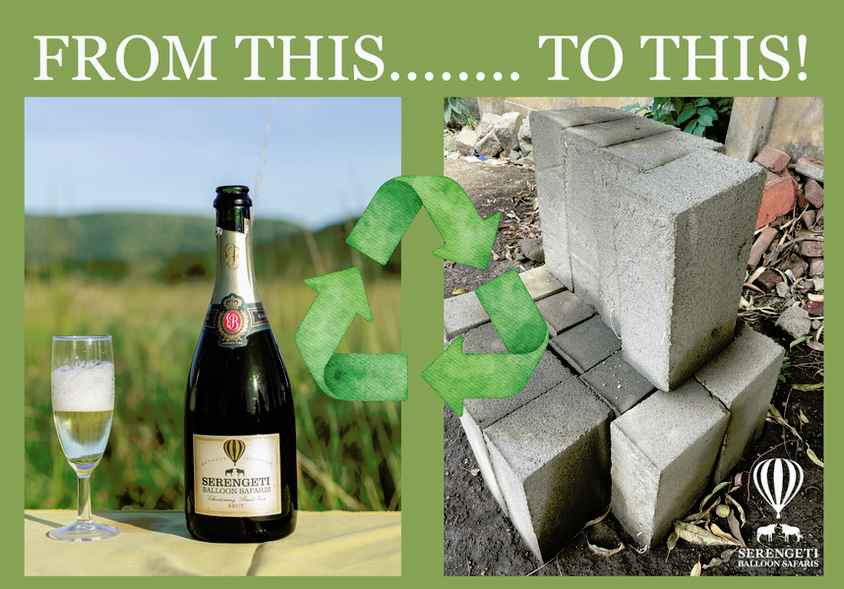
At Okota, the glass is crushed and processed before being mixed with cement and formed into building blocks. These blocks are currently undergoing strength testing at Arusha Technical College, with early results showing strong potential, indicating they may be even more durable than conventional cement bricks. A final addition of 5–10% biochar, produced in significant quantities, enhances the environmental performance of the blocks without compromising their structural integrity, resulting in a carbon-neutral building material.
A New Form
The glass becomes carbon-neutral building blocks—stronger than conventional building materials.
The Impact Beyond the Flight
This initiative demonstrates a working circular economy, where moments of celebration contribute to long-lasting community value. It aligns with our commitment to carbon neutrality and responsible tourism.
When you toast with us, you’re not just celebrating a flight you’re helping build a more sustainable future.