
ATTA®: Air Travel to Africa Growing Despite Global Disruption
New analysis released today at Africa's Travel Indaba by ATTA® – the African Travel & Tourism Association – reveals aviation growth to the continent for the early peak season months of May and June compared to the same months in 2025.
Using new comparative aviation data analysis produced by the leading data intelligence company for travel and tourism - Data Appeal and Mabrian - (part of Almawave / Almaviva Group), ATTA® examined airline schedules before the escalation of the Iran war on 28 February 2026 and compared them with updated schedules for May and June 2026 travel.
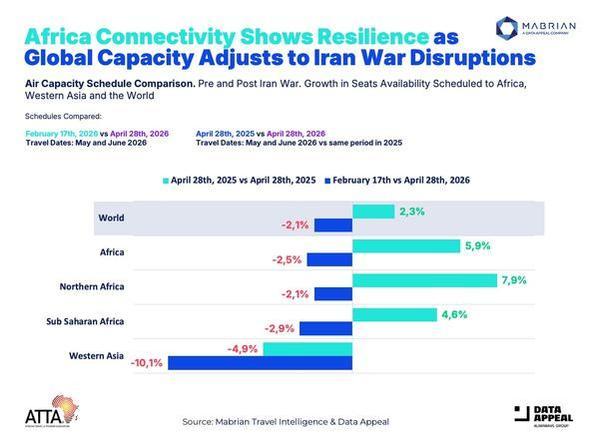
The findings show that global airlines have reduced worldwide seat capacity by -2.1% as carriers respond to airspace disruption, operational uncertainty, rising fuel prices and increasing insurance costs.
The strongest impacts are closest to the conflict zone:
- Western Asia has seen seat capacity fall by -10.1%
- Southeast Asia recorded a -7.2% reduction
- Sub-Saharan Africa saw a more moderate decline of -2.9%
- North Africa recorded a -2.1% adjustment
But, despite the disruption when comparing May–June 2026 schedules against the same period in 2025:
- North Africa is still recording +7.9% year-on-year growth
- Sub-Saharan Africa remains positive at +4.6%
- Global seat capacity overall is up +2.3%
- Western Asia remains the only major region still in contraction at -4.9% year-on-year
Virginia Messina Group CEO of ATTA® said: “The conflict has created immediate operational challenges for aviation globally. Airlines are dealing with disrupted corridors, higher fuel prices and longer routing times.
“But Africa’s skies have remained open and operating smoothly with air capacity up approximately 6% in average year-on year. While there has been some short-term schedule adjustment, the continent continues to outperform many regions globally and the figures underline Africa’s growing strategic importance. Members are telling us customers are either seeking reassurance, but still travelling or postponing trips rather than cancelling.”
The analysis also shows that Africa’s international connectivity continues to expand despite the current volatility.
In 2026:
- 70 non-African countries will operate direct flights to Africa
- More than 89 million inbound seats are scheduled to the continent
- Total inbound capacity is still forecast to grow by +4.4% year-on-year
Europe remains Africa’s largest external aviation market with more than 50.7 million inbound seats scheduled for 2026, growing by +5.6%, while GCC countries continue to play a critical role in connecting Africa globally despite regional disruption.
Among the strongest-growing origin markets to Africa are: Russia (+23.1%); Portugal (+13.4%); Italy (+11%); China (+11%); India (+9.3%); United Kingdom (+8.6%) and Türkiye (+8.6%).
The report also highlights strong momentum within Africa itself. Intra-African connectivity is forecast to exceed 112 million seats in 2026, up +6.6% year-on-year, with particularly strong growth in medium-haul and long-haul regional routes.
South Africa remains Africa’s largest intra-continental market with 24.6 million seats, while Nigeria (+14.9%), Algeria (+15.9%), Mauritius (+16.6%) and Madagascar (+14.6%) are among the fastest-growing aviation markets on the continent.
According to Carlos Cendra, Chief Marketing Officer at Data Appeal: “Africa has a clear medium- to long-term opportunity to leverage growth in both international and regional connectivity to accelerate its tourism sector. In a global market where demand is highly fluid and shifts rapidly in response to the geopolitical environment, the continent now holds a competitive advantage to emerge as a compelling alternative for travellers seeking sustainable and authentic new experiences.”
ATTA® says the latest figures demonstrate that while geopolitical instability is reshaping global aviation patterns, Africa is increasingly being viewed as both a resilient tourism destination and an emerging strategic aviation corridor.